Subsidiaries
Global
Home News Center Group News
2026-10-31
Highlander GALAXY Leadership Talent Program Opens Its Third Session: The BLM Model Decodes Strategy Execution

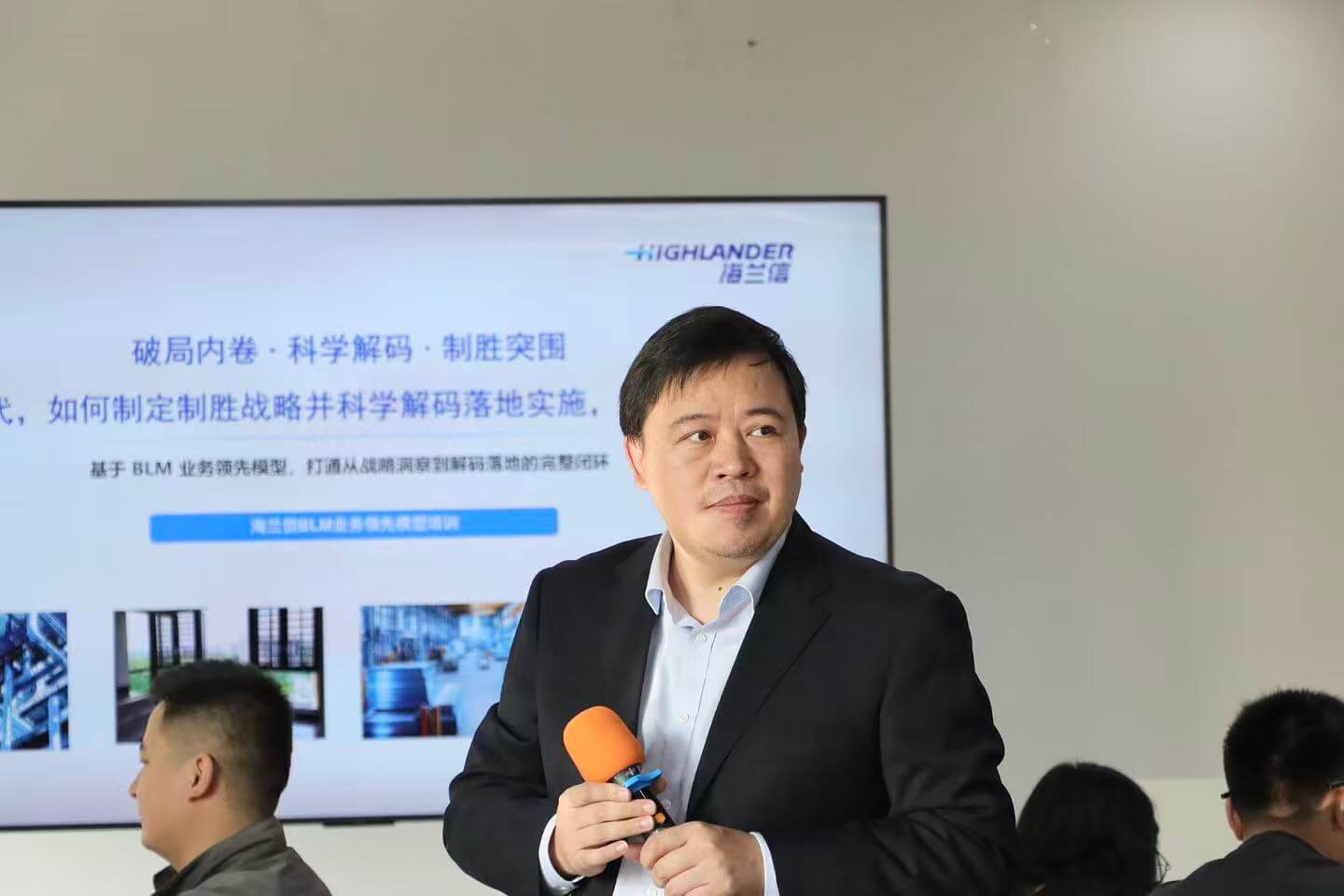
From October 30 to 31, the third session of Highlander’s 2026 GALAXY Leadership Talent Program will be held at the Highlander Intelligent Innovation Park in Nantong. This session focuses on strategic planning and decoding. Built around the course “The BLM Business Leadership Model — Charting the Growth Blueprint,” it is divided into two stages, “setting direction” and “strengthening execution,” with a workshop in between, where participants bring real problems from their own businesses to discuss.


Breaking Down Misconceptions First, Linking Strategy with Execution

The first module of the course does not start with tools. It starts with a diagnosis. Strategy usually fails not at the execution end but at the starting point: targets are set without enough stretch, and what looks prudent in fact misses the window for industry consolidation; a trend one has observed is mistaken for strategy, and the direction drifts year after year; there is a direction but no matching tactics and plans, so there is nothing to grip once it reaches execution. These situations can be seen at the strategy meetings of most companies, and they are precisely what this module sets out to clarify.

BLM was developed jointly by IBM and Harvard Business School and introduced into China by Huawei in 2009; since then it has been widely applied by leading Chinese enterprises. Its purpose is to put strategy and execution on the same map for discussion: starting from the gap, a performance gap can be closed through efficient execution, whereas an opportunity gap requires a different business design altogether. If the two are misjudged, the measures that follow can hardly work.


Guided Practice with a Mentor, Bringing the Method Back to One’s Own Business

The session features a specially invited mentor, Zhuang Zhiping, who holds a master’s degree in economics from Nankai University and formerly served as Strategy Consulting Director at IBM and as a strategy consulting expert at Accenture. He has provided strategy consulting and implementation coaching to more than thirty Fortune Global 500 and Fortune China 500 companies.


Fortune magazine has a frequently cited statistic: fewer than 10% of well-formulated strategies are effectively executed. Strategy is often not set wrongly; it stalls in the last mile. Targets are not broken down to individuals, each department keeps its own books, middle managers cannot explain how strategy relates to their own work, and attention stays fixed on lagging indicators such as quarterly revenue — all of these are common sticking points. This is also why the session devotes most of its length to execution. At the organizational level, the course returns to Chandler’s judgment that “structure follows strategy”: once strategy is set, the first priority is to adjust the organizational structure, rather than having the old organization take on the new strategy.


Let Key Talent Practice First, and Let Capability Take Root

Strategy is not the business of a few. Now that the company has run the Leadership Talent Program to its third session, the path is clear: the first session consolidated the fundamentals of financial management, the second added capability in AI tools, and the third addresses the question of judging direction. The three sessions connect with one another, aiming to enable this group of young key talent both to read the numbers of the business clearly and use digital tools well, and to grasp direction and drive implementation.

Next, the company will continue to advance a series of training programs around six capability areas, building a reserve of management talent that understands the business and can take on operating targets for the long-term development of its two core businesses, data centers and marine technology.