A "Digital Heart" Beneath the Sea: Lingshui's Deep-Sea Fish Farms Experiment with "Data-Driven Aquaculture" | Seeking "the Way" in the Ocean
Once, the people of Lingshui sought from the sea just a fish, a meal. Now, they seek from the sea an entire value chain, a new horizon. From "living off the sea" to "seeking the Way in the ocean" — a shift of just a few words, but what it changes is vision, ambition, and the industrial aspirations of this city.
Hainan is now charging toward the goal of "growing strong by the sea, and building another Hainan on the water." Lingshui is a critical piece in this deep-blue breakthrough. The 18th parallel north endows it with the backdrop of a "golden breeding ground" — it is a key early propagation base for golden pompano fry in China, producing fry at an impressive annual scale. But this is just the beginning.
Seeking the Way in the ocean means seeking the way of seed breeding — holding tight to the aquatic "chip"; the way of symbiosis — turning fishing rafts into guesthouses, shifting from "living at the mercy of the weather" to "building livelihoods by the sea"; and the way of digital intelligence — where an underwater data center coexists with fish schools, and computing power becomes the freshest "catch."
Hinews.cn — Nanguo Metropolis Daily presents the series report "Seeking the Way in the Ocean — Lingshui's Deep-Blue Breakthrough," chronicling the real industrial transformation and human stories beneath this expanse of blue.
At six in the morning, the surface of Lingshui's Clear Water Bay was not yet fully bright. Twenty deep-sea net cages rose and fell gently in the grey-blue dawn light. Na Zhongtao, head of aquaculture for the smart cage division at Lingshui Gaoen (Hainan) Technology Co., Ltd., stood on the shore and opened the digital intelligence platform on his phone. Wave height, water temperature, dissolved oxygen, blue-green algae concentration — dozens of data points refreshed simultaneously. "Wave height 1.2 meters — conditions are suitable for going out to sea," he said to his colleague beside him, his tone as flat as if he were reporting the day's weather.
Behind this ordinary morning lies something that is quietly unfolding: Lingshui's deep-sea aquaculture, which once relied on compass navigation to go out to sea and on gut feel to feed the fish, now has a "digital heart" sunk beneath the waves, beginning to let data participate in the decisions around fish farming.
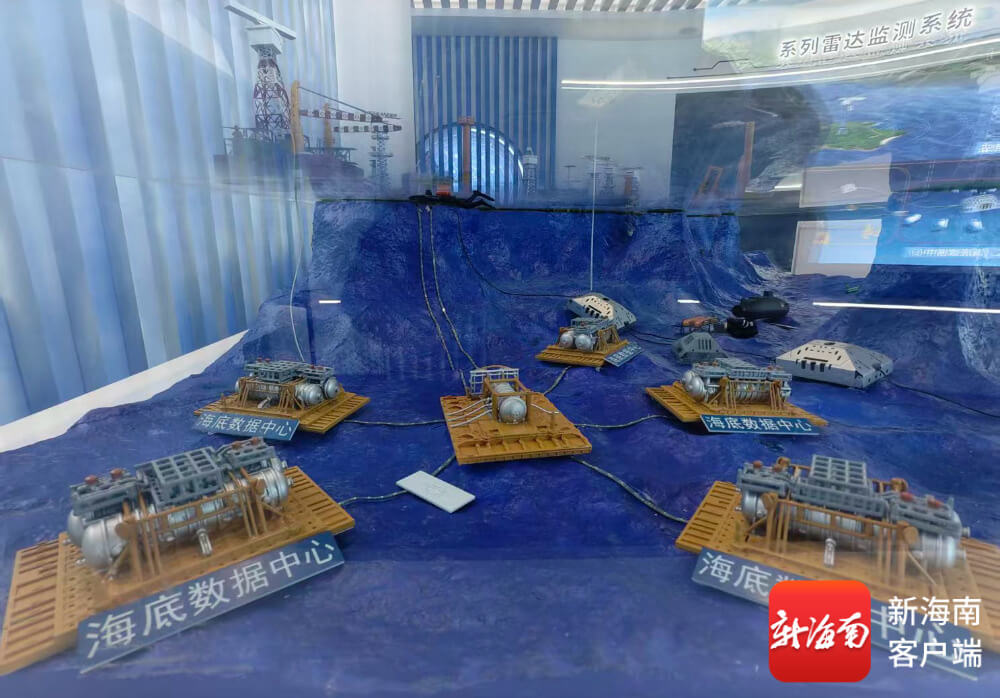
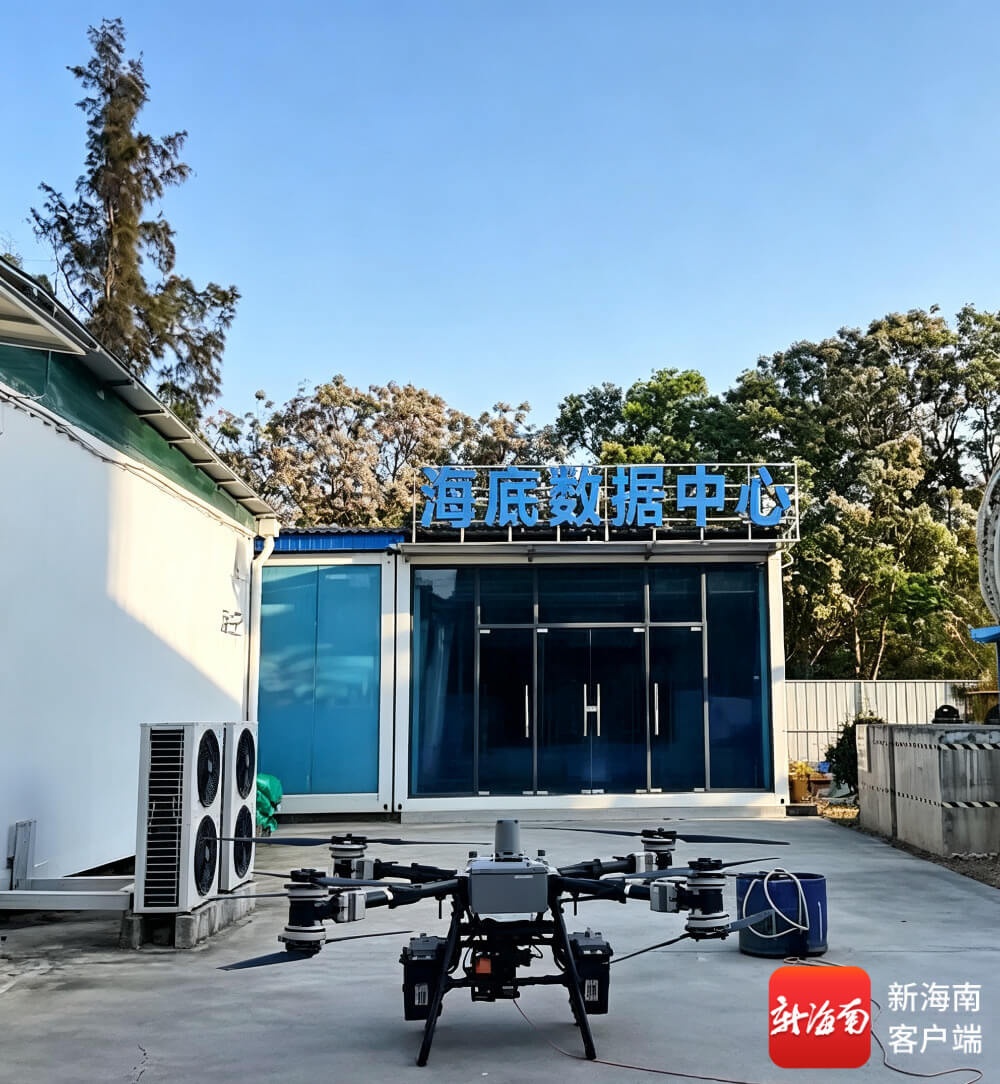
Hainan Lingshui Underwater Data Center. Photo by reporter Sha Xiaofeng
Those Years, When Fish Farming Depended on the Heavens
Xin Peng is mainly responsible for intelligent operations within the team. His day-to-day interactions are more with data and systems than with nets and fish. But having talked often with fish farmers and veteran hands, he knows the hardships of this trade inside and out. Na Zhongtao has spent ten years at sea. He has a mental ledger of how to raise golden pompano, but most of what's written in that ledger is "resigned acceptance."
"In our line of work, the biggest risk is what you can't see," he says, pointing at the distant net cages. Nearshore aquaculture is highly sensitive to hydrological changes — low dissolved oxygen, algal blooms, typhoon swells — any one anomaly can affect the stock in a single cage within two or three days. Yet traditional patrols rely entirely on taking a boat out to sea and observing with the naked eye. By the time you notice fish surfacing and gasping, the optimal window for intervention has often already passed. Large-scale algal blooms are not uncommon along the coast, and when they hit, the losses tend to come in swaths. That is exactly why "can we know in advance?" has long been a question mark in the minds of many fish farmers.
The second difficulty is "not being able to get the numbers right." To gauge how big the golden pompano have grown and how much feed they need, the traditional approach is to take a boat out, cast a seine net, haul up a few dozen fish, measure them, weigh them — half a day's hard work, yielding a sample of only around a hundred fish with a significant margin of error. And since feed accounts for the lion's share of aquaculture costs, how much to feed largely comes down to experience — too little and the fish won't grow; too much and the money sinks straight to the seabed.
The most vexing problem, however, is "people." Work at sea is grueling and dangerous. Feeding in heavy wind and swell, the boat pitches so hard you can barely stand — one moment of inattention and it's an accident. Young people don't want this kind of work, and fish farms are perpetually short-handed. Relying on experience, on physical labor, on living at the mercy of the weather — this old road was growing narrower by the day.
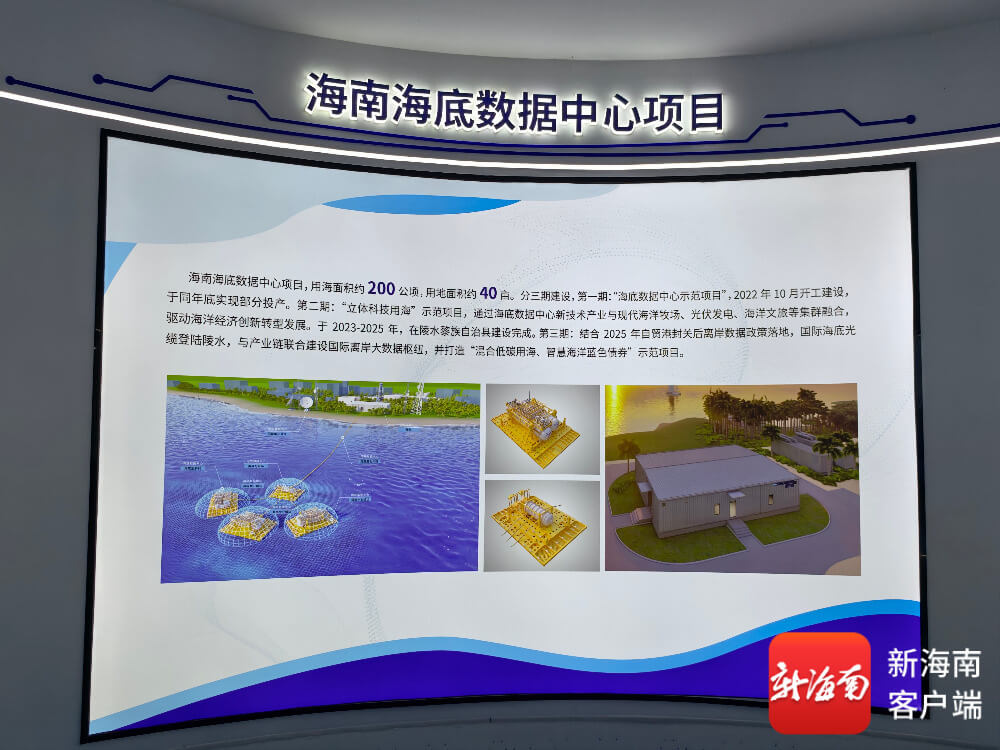
Hainan Lingshui Underwater Data Center. Photo by reporter Sha Xiaofeng
A Computer Added to the Seafloor
The turning point came somewhat unexpectedly.
In 2023, with support from relevant Lingshui authorities, the world's first commercial underwater data center was officially put into operation in Lingshui's waters. Servers were submerged more than 30 meters beneath the sea, cooled by the natural circulation of seawater, consuming far less energy than a land-based data center of comparable scale, with network latency also remaining very low. As it happened, the data center was only a few nautical miles in a straight line from the deep-sea net cages of Clear Water Bay.
"What does a data center have to do with fish farming?" During the interview, the reporter didn't catch on at first either. It wasn't until Xin Peng explained that it clicked — the hydrological data collected by surface buoys and the fish school imagery captured by underwater cameras could be fed directly into the nearby subsea computing power for real-time analysis, without needing to be relayed all the way back to a shore-based server room via a roundabout route.
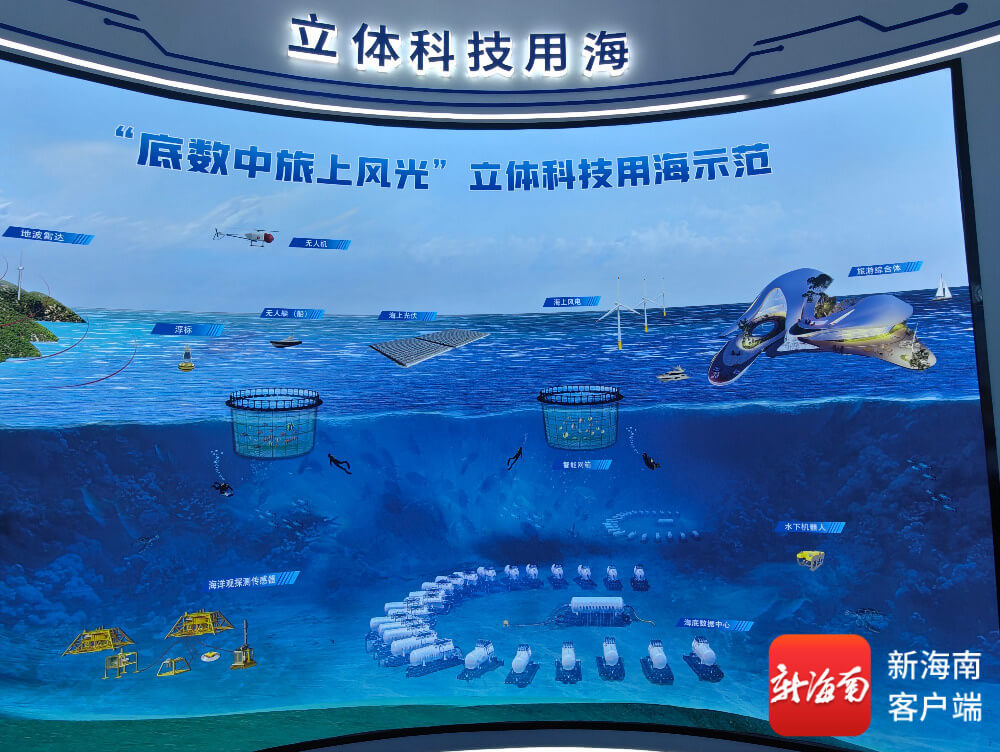
Hainan Lingshui Underwater Data Center. Photo by reporter Sha Xiaofeng
A data framework was thus assembled. On the surface, wave spectrum buoys and ecological buoys report hydrological indicators at regular intervals. Below the surface, binocular cameras and sonar have been deployed — currently mainly on select experimental net cages — to observe the fish schools. The data is fed into the subsea computing power and analyzed by AI models, with results pushed to an intelligent deep-sea aquaculture service platform. This system is currently open for use by local aquaculture enterprises.
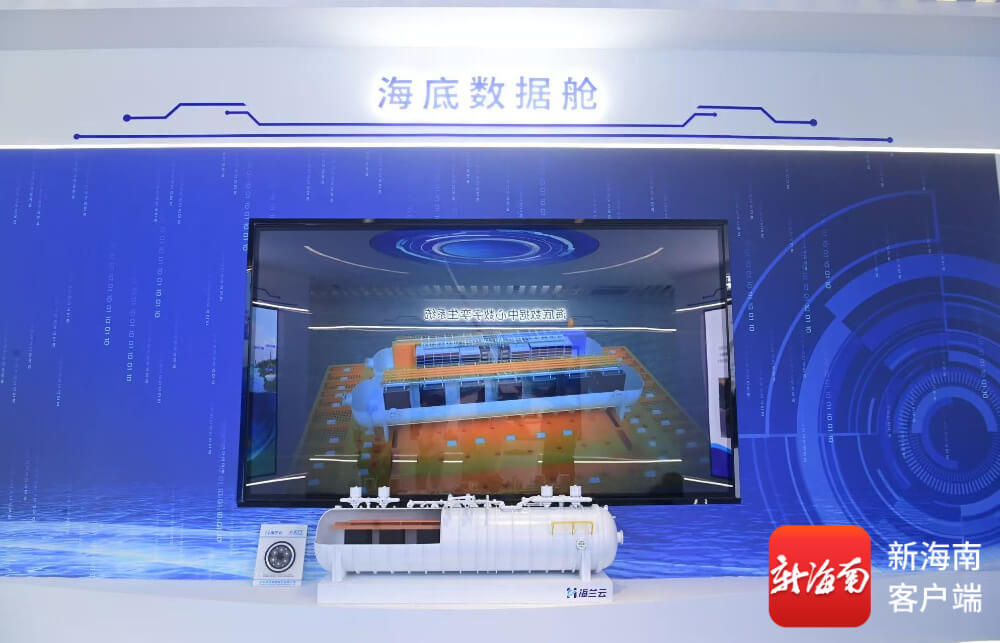
Hainan Lingshui Underwater Data Center. Photo by reporter Sha Xiaofeng
Three Scenarios That Say Goodbye to "Going by Gut Feel"
The first scenario is turning what was once the "invisible underwater world" into recordable data. Dozens of water quality and hydrological parameters — dissolved oxygen, water temperature, blue-green algae concentration, and more — are now collected at regular intervals by surface buoys and archived on the platform, forming an objective data ledger of the entire aquaculture process. This past June, the platform detected that blue-green algae concentrations in the Clear Water Bay waters were higher than usual, and this change was faithfully recorded. Xin Peng says what the system can do right now is to continuously record and accumulate data about the underwater environment. "As for how to put this data to better use in the future, that still needs time and more samples to validate."
"Before, by the time you took a boat out and saw the water had changed color, it was already too late. Now the data arrives first, and only then do people move," Xin Peng says. Having even one step of advance warning gives you a bit more confidence.
The second scenario hides within the lens of the underwater cameras. In the past, to know how much the fish had grown, you had to sail out, cast a net, haul them up, and weigh them — half a day of hassle, and the fish were stressed besides. Now, in the experimental cages equipped with binocular cameras, the cameras automatically capture images of the fish schools every day. AI models estimate the body length and weight of the fish through the parallax between the two "eyes," plotting a growth curve day by day. Compared to seine-net sampling, this approach yields more samples and disturbs the fish much less. Xin Peng opens the backend — for these trial cages, you can see average size, growth rate, and size distribution. That said, he is candid that this methodology is still being validated and optimized on experimental cages. How small the margin of error needs to be and whether it can be rolled out to all cages remain questions still being explored.
The team is testing drone-assisted feeding. Photo courtesy of Lingshui Gaoen (Hainan) Technology Co., Ltd.
The third scenario plays out in the feeding process. The team is testing drone-assisted feeding: a drone carrying a feed hopper flies along a preset route to the target cage, disperses the feed, and then automatically returns to base for recharging. The envisioned goal is to form a closed loop of "computing power generating a plan → task dispatch → drone execution → underwater camera feedback → model re-optimization." But this workflow is still in the testing phase. To what extent it can genuinely improve feed utilization rates and lower operational costs still needs more data to verify — it remains too early to talk about concrete figures.
From a Single Fish to a Calling Card
What this system can do goes beyond what's visible right now.
A digital aquaculture ledger has been established. Every batch of fry — from stocking numbers, daily feeding records, cage transfers, disease treatments, to disposal of dead fish — is retained online. The next step, the team plans, is to build a traceable digital archive for Lingshui golden pompano, so that consumers can look up the key information about a fish's growth journey from hatchery to harvest.
"The foundation of a brand is trust, and the prerequisite for trust is transparency," says Xin Peng.
At the same time, the project is collaborating with institutions including the South China Sea Fisheries Research Institute, the East China Sea Fisheries Research Institute, and Hainan Tropical Ocean University to experiment with applying AI to fish disease diagnosis — matching laboratory anatomical and testing data from diseased fish with abnormal swimming behavior captured by underwater cameras, and exploring the transition from "salvaging the situation once fish start dying" to "early warning." This part of the work is still underway.
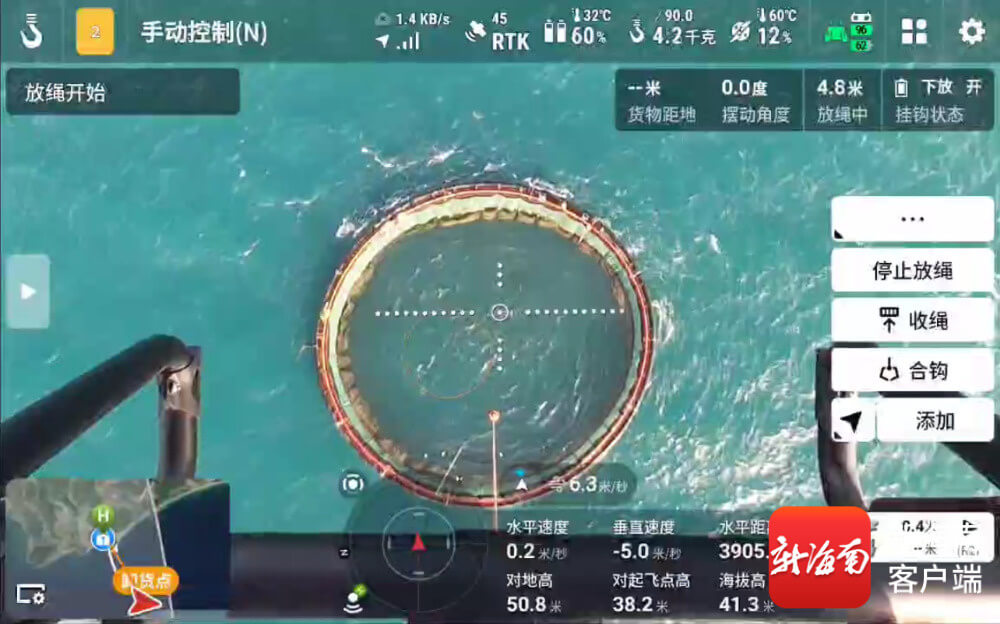
The team is testing drone-assisted feeding. Photo courtesy of Lingshui Gaoen (Hainan) Technology Co., Ltd.
Into the Deeper Blue
What's happening now is only the beginning. As the underwater data center's computing power gradually scales up, the team is also envisioning more possibilities.
For instance, connecting more buoys and underwater equipment to progressively expand data coverage across the sea area, slowly mapping out currents, thermal stratification, and nutrient distribution. Or, for instance, using the accumulated aquaculture data to inform farming decisions, and even extending into scenarios such as aquaculture insurance loss assessment and financial lending. That said, all of this currently remains at the ideation and exploration stage. Whether it can be realized and how it will land all depend on subsequent practical advances — it is still too early to draw conclusions.
From relying on experience to "live off the sea," to trying to rely on data for "digital-intelligent sea farming," Lingshui is exploring a new path of applying data to aquaculture decisions. It may not reach perfection in a single stride, but the direction is clear — let data do more of the talking, and let experience and intuition shoulder a little less of the risk.
On the morning sea, servers operate quietly more than 30 meters underwater. Onshore, Xin Peng puts away his phone and heads toward the dock. On the screen, wave height is 1.2 meters, water temperature is suitable. Making data useful step by step and consolidating the functions that work well — that is what this team is focused on right now.
(Article republished from Hinews.cn / New Hainan Client)
Chief Planner: Zhou Yuan
Planner: Liu Liping
Coordination: Sha Xiaofeng, Zhang Ye
Reporter: Lin Shitang
Photography: Cao Zhi
Editing & Packaging: Xiao Jingjing