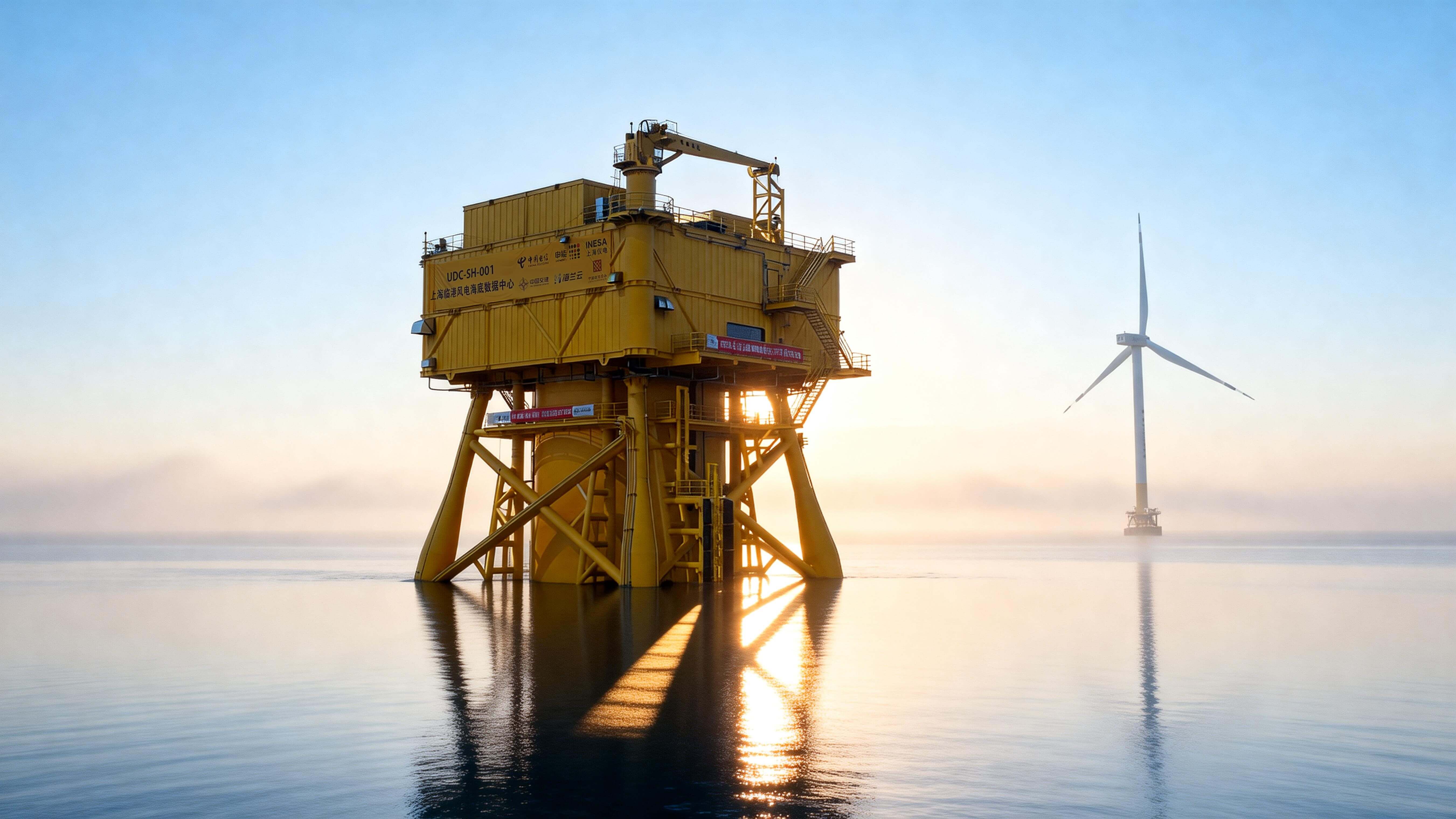

Located approximately 10 km offshore to the east of Lingang, the Lingang Subsea Data Center represents a total investment of RMB 1.6 billion, with a planned total capacity of 24 MW. The project pioneers a dual-core technology combining "direct green power supply from offshore wind" with "natural seawater cooling," deeply integrating offshore wind farms, the deep-sea environment, and computing infrastructure. With a green electricity supply ratio exceeding 95%, the facility draws power directly at sea via integrated power-and-fiber-optic submarine cables. It also harnesses deep seawater — which maintains an average temperature of 15°C year-round — as a natural cold source: a copper-tube refrigerant circulation loop delivers power-free (passive) cooling, keeping the PUE stably at an industry-leading 1.15. Compared with conventional land-based data centers, overall energy consumption is cut by 30%–40%, water use by 100%, and land use by more than 90%. The project also includes a Phase II plan in the far-reaching deep sea with a planned capacity of 500 MW, which will replicate and upgrade the "offshore wind direct green power + natural seawater cooling" dual-core model at scale, further expanding the horizons of deep-sea computing.
The strategic investment in Hailanyun is an important move by the National Green Development Fund to proactively respond to the digital era's demand for green computing power and to actively cultivate green new quality productive forces. By "drawing land, cooling sources, and green electricity from the ocean," the project tackles at its root the "three highs" dilemma of traditional data centers — high electricity consumption, high water consumption, and high land occupation — and eases the twin shortages of electricity and land that Shanghai, as a megacity, faces in coordinating computing capacity with energy supply. On the basis of full-capacity operation at 24 MW, the project is projected to save approximately 61 million kWh of electricity each year, with an equivalent CO₂ emission reduction matching the annual carbon sequestration of 1.6 million trees, while also saving more than 40,000 tonnes of fresh water annually. This model charts a replicable demonstration path — a "Shanghai solution" — for the green and low-carbon transformation of digital economy infrastructure and for the deep integration of the marine economy with the digital economy. Moreover, with network latency as low as 0.5 ms to coastal cities, the facility is well positioned to serve latency-sensitive market demand spanning AI inference, embodied intelligence, intelligent manufacturing, and cross-border data, achieving two-way on-site absorption of green power supply and computing demand. In doing so, it actively supports the Lingang Special Area and Shanghai as a whole in building a green and intelligent computing ecosystem and an international digital hub.

Looking ahead to the 15th Five-Year Plan period (2026–2030), the National Green Development Fund will continue to play its dual role as a "ballast stone" and a "booster," using the Hailanyun Lingang Subsea Data Center as a demonstration to scale up the innovative model that integrates green computing with clean energy, and to contribute national-level capital strength to building a Beautiful China and achieving the goals of carbon peaking and carbon neutrality.
Contributor: Huang Li
Reviewer: Zhang Weili
(Reprinted from the National Green Development Fund)
Latest News | Company Highlights
Benchmark Cases
010-59738989 ext. 0 (Monday to Sunday 9:00-22:00)
Supervision Email: shenji@highlander.com.cn
Building 10, No. 7 Dijin Road, Haidian, Beijing
Copyright © 2025 Beijing Highlander Digital Technology Co., Ltd. All rights reserved.